
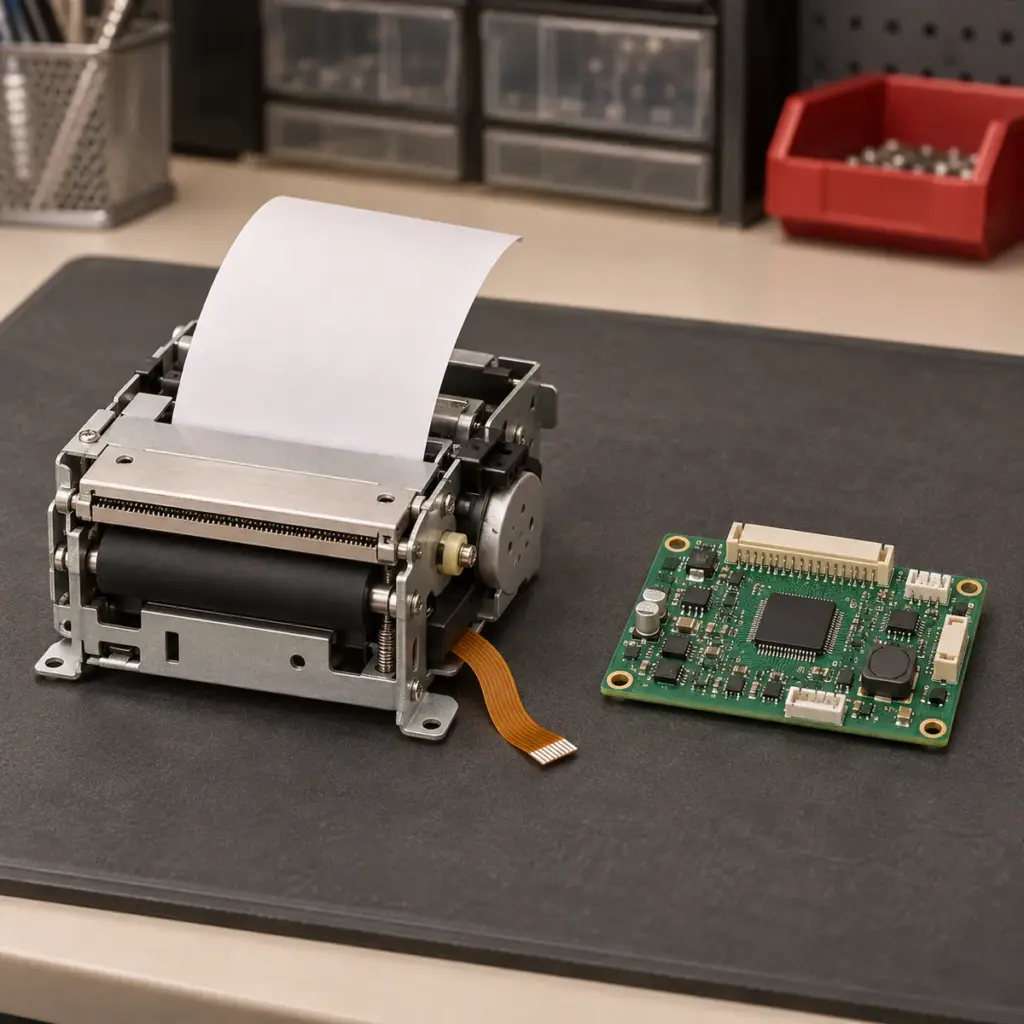
An equipment manufacturer wants a second source for the printer mechanism inside an established machine. The enclosure works, the application software works, and the existing controller board already handles printing. Replacing all of them would turn a component purchase into a redesign project.
Can the original board stay? Yes, when the replacement mechanism is compatible with the way that board drives and monitors it. The important relationship is between the board and the mechanism, including the behavior expected by the board’s firmware. Matching the paper width or fitting the connector establishes only part of that relationship.
For a thermal printer mechanism replacement, the useful starting point is therefore the existing equipment: what mechanism it uses, what controls it, and which parts of the machine the project needs to retain.
Start at the Connection Below the Printing Commands
Consider an illustrative project involving an 80mm receipt-printing assembly. The host sends its usual print commands to the existing board. A replacement mechanism is installed, the same job is sent, and a receipt appears. That is a useful first result, but it does not establish everything the equipment needs to do.
The host and the bare mechanism operate at different levels. A controller may accept ESC/POS or another command language, turn the job into a dot pattern, and coordinate the physical printing process. The mechanism normally receives the head-control and motor-drive signals needed to produce that output, rather than interpreting the host’s receipt commands itself.
Consequently, an unchanged host command set does not establish compatibility between the board and a replacement mechanism. The board may still need a different mechanism profile or drive arrangement. Our thermal printer controller board article explains that division of work in more detail.
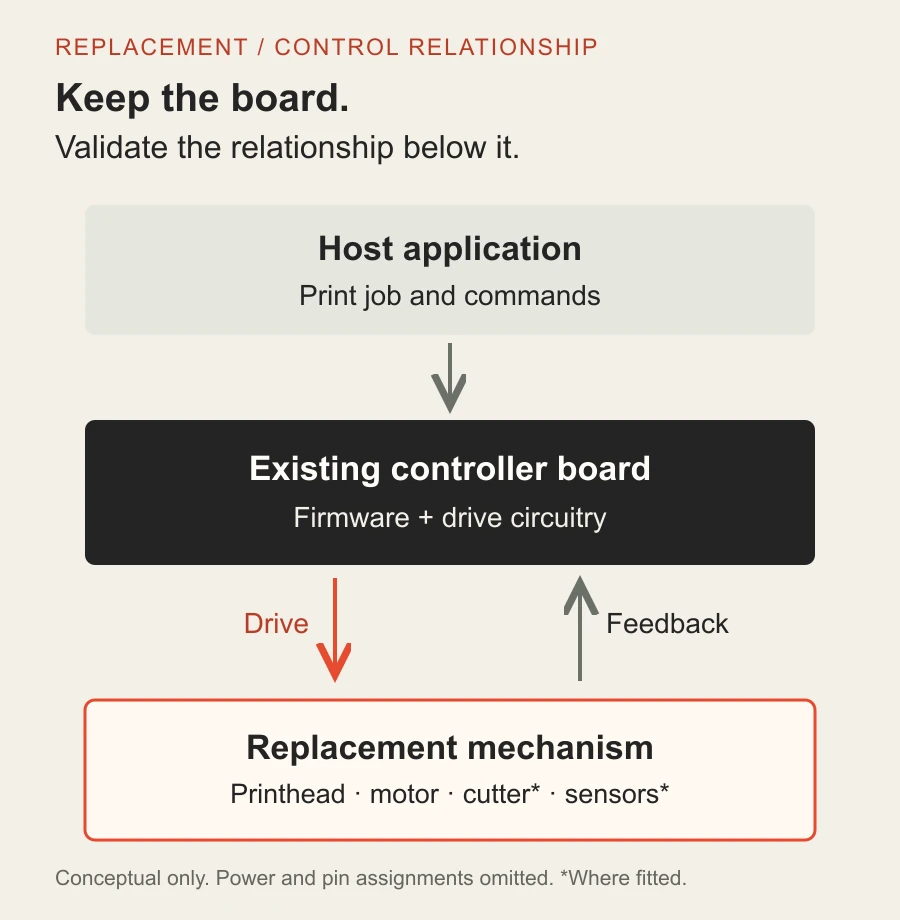
Conceptual control relationship. Power supplies and individual connections are omitted; this is not a wiring diagram or a compatibility statement for a particular board.
For a direct replacement, the aim is to preserve the behavior the installed board already expects at that lower connection. A plug that physically fits does not establish its pin assignments, electrical requirements or signal behavior. These must be established before connecting and powering a proposed replacement.
The Existing Firmware Already Assumes How the Mechanism Behaves
The controller does not simply pass an image through a cable. Its hardware and firmware work with the characteristics of the connected mechanism. Some assumptions are visible in a connector drawing; others appear in the way the printer is driven during a job.
Heating Is More Than Choosing a Darkness Setting
In a thermal printhead, data is transferred to driver circuitry and held for printing. The head’s heating elements are then energized under controlled conditions. ROHM’s explanation of thermal printhead driver ICs describes the roles of data, latch and strobe signals, including how the strobe pulse controls energizing time. Exact signal requirements belong to the selected head’s documentation.
This matters during replacement because the existing controller’s drive settings were chosen for a particular head and mechanism. A different head arrangement can require a different way of transferring data or applying heating pulses. A darkness adjustment exposed to the operator does not establish that the underlying drive settings are suitable.
Printhead temperature monitoring is part of the same relationship. The controller needs to interpret the actual sensing arrangement correctly and respond as intended as operating conditions change. The relevant comparison is the documented mechanism-to-board behavior, rather than whether two connectors have the same number of contacts.
Paper Movement and Feedback Belong to the Same Job
The board also coordinates paper movement with the printed lines. Motor characteristics and the relationship between commanded movement and actual paper advance matter to the result. A receipt can contain recognizable text while still having an unintended length or inconsistent feeding behavior.
For a mechanism with a cutter, the board must also operate that cutter and interpret the relevant feedback. Paper detection and platen-position detection, where provided, need to produce the responses expected by the existing system. A normal print job alone does not exercise those conditions.
This does not mean that every replacement requires new firmware. A compatible replacement can be designed to preserve the installed control arrangement. It means that keeping the same board and keeping the same firmware are requirements to establish explicitly, rather than conclusions drawn from appearance.
Why One Successful Receipt Is Only the Beginning
Return to the illustrative 80mm assembly. Its first short receipt contains a few lines of text. The real equipment may later print longer jobs, include a large logo, repeat jobs through a busy period, or stop while waiting for an operator. Those patterns ask different things of the printing assembly.
An evaluation should therefore use representative customer jobs and the intended operating pattern. Compare the printed output and paper advance, observe how the assembly behaves over the required run, and check the equipment’s handling of relevant conditions such as paper-out, opening and closing the platen, and cutter operation when fitted.
The point is to establish the behavior of the complete combination: replacement mechanism, existing board, installed firmware, power arrangement, paper and enclosure. Acceptance criteria should come from the actual application and the component documentation. There is no single universal receipt count or test duration that establishes compatibility for every machine.
Possible changes in print density, feeding or fault response also need to be interpreted in context. They are reasons to investigate the combination, not proof of one particular cause. Adjusting several settings at once can make that investigation harder. Preserve the original setup information and compare changes in a controlled way.
For a procurement team, this is a joint engineering review with the supplier. You do not need to derive the heating control or diagnose the motor yourself before asking whether an alternative is available.
A Concrete Example: Keeping the CAPD347 Installation
Uright offers the UR347C as a CAPD347-compatible thermal printer mechanism. It is intended for direct replacement in CAPD347-based equipment while retaining the existing installation, connector and pin arrangement, control board and firmware.
The standard UR347C supply is the printer mechanism with an integrated automatic cutter; a control board is not included. That supply arrangement fits a project whose existing equipment already provides the controller. Send the original mechanism identification and equipment details so we can discuss the replacement and a sample evaluation in your setup.
Here the purchasing question is specific: can an alternative printing assembly be supplied while preserving an established machine? The product’s maximum speed is a separate specification. Installing a mechanism with a higher published maximum does not by itself change the operating speed commanded by the original controller.
Seiko Instruments and CAPD347 identify the original reference product. UR347C is a Uright product, not a Seiko-manufactured part.
Tell Us What You Need to Keep
Start with the original mechanism model or a clear photo of its identification, together with a photo of the installed assembly. Tell us whether the project needs to retain the control board, firmware, connector arrangement and mounting position. If the board model or existing technical documents are available, include them; a complete technical specification is not required for an initial conversation.
Also explain the reason for the change: a second source, ongoing replacement supply, an equipment update or an operating problem. That context helps us discuss a practical route and the information needed next.
Send what you already have by email or WhatsApp. We can review the existing arrangement with you and discuss a suitable mechanism and evaluation approach.