
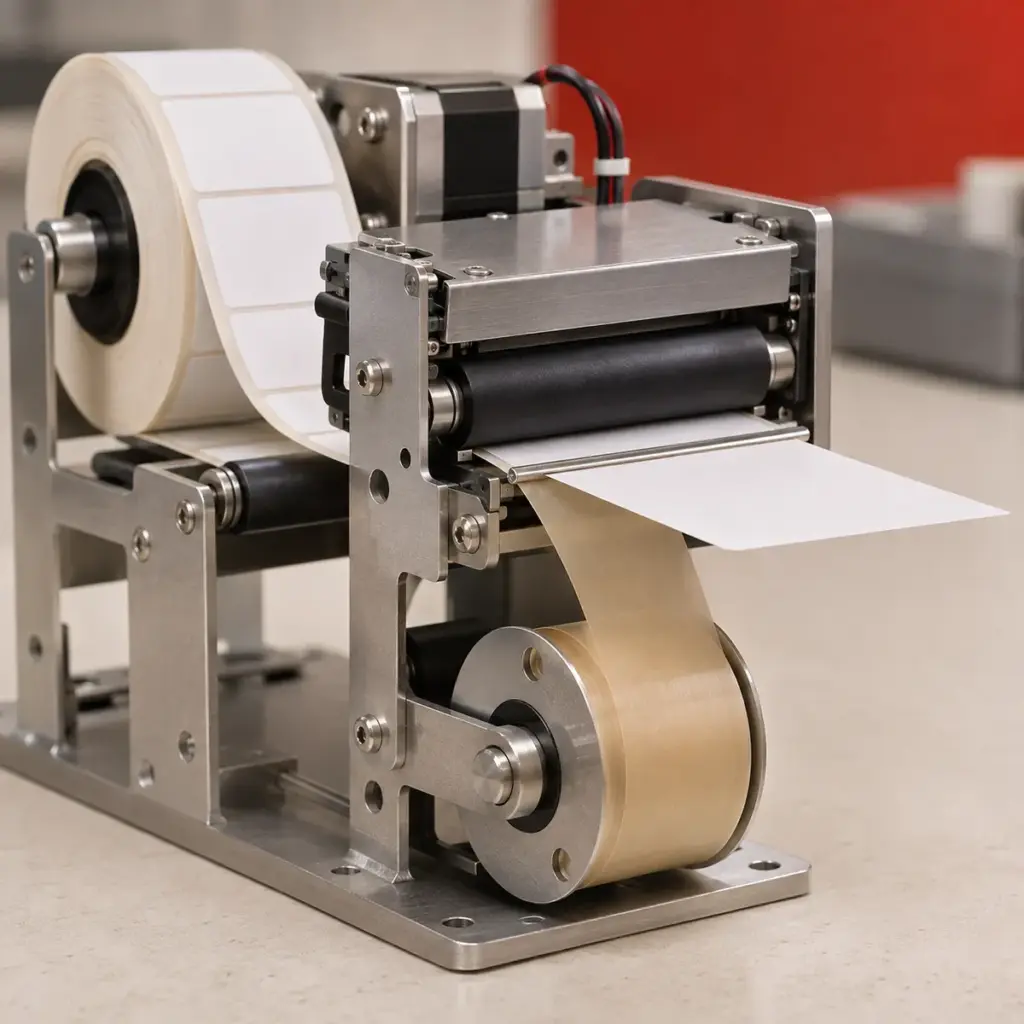
A label can be printed correctly and still be inconvenient to use. An operator may have to separate it from the backing by hand. Inside a machine, the printed label may need to reach a pickup position while the backing is collected somewhere else.
A label printer module with a peeler and liner rewinder addresses that part of the workflow. It prints on the label stock, separates the label from its backing and collects the used liner. What happens next depends on how the label is taken and applied. Understanding that handoff is a useful starting point when discussing an integrated labeling project.
Follow the Label and the Backing Separately
Self-adhesive label stock combines the label face material and adhesive with a release liner, also called backing paper. Before dispensing, the liner carries the labels through the printing arrangement. After dispensing, the label and liner follow different routes.
At a peel edge, the liner changes direction sharply. The label tends to continue forward and separates from the liner. The intended result is a label presented where a person or another mechanism can take it, with the backing directed away from that pickup area.
The peel edge therefore does more than provide a convenient place to pull paper. Its geometry and the selected label material work together. A label that follows the liner around the edge has not been presented as intended, even if its printed text is clear. A label that releases too early can also create a handling problem before reaching the intended position.
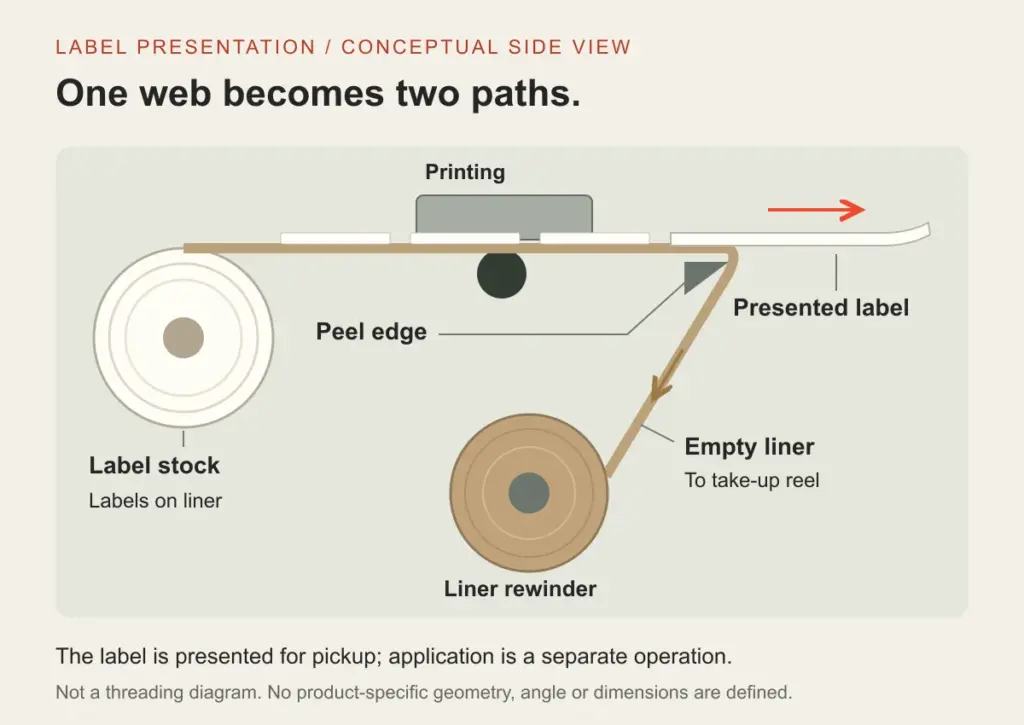
Conceptual process illustration. Label stock, the presented label and the empty liner are shown separately for explanation. This is not a threading diagram, specified peel angle or product-specific mounting drawing.
Material behavior matters here. In its label-quality guidance for automated labeling, cab explains that labels separate as the liner passes over an edge and that release behavior must suit the equipment. Its detailed requirements apply to its own systems. For another module, assess the intended label stock against that module’s supported media and dispensing arrangement.
The useful question is whether your actual labels can be presented consistently in the intended setup. A similar-looking roll does not establish the same release behavior. Label dimensions, face material, backing and the intended pickup arrangement belong in that discussion.
The Rewinder Collects Empty Liner
A liner rewinder gathers the backing after the labels have been removed. That is different from winding a finished roll of printed labels that are still attached to their backing. The two tasks should be named separately when describing the required supply.
Without a suitable collection arrangement, loose liner needs somewhere to go. In a compact enclosure, that can affect access to other components and the space around the pickup point. A rewind reel provides an organized destination, but its growing diameter and removal method still need to be considered.
A Growing Reel Changes the Motion
The rewind roll becomes larger as more liner is collected. At a larger radius, one revolution takes up more material. Consequently, the rotation needed to collect a given length changes as the roll grows. The rewinding arrangement must accommodate the actual feed and collection behavior rather than simply turn at an arbitrary fixed speed.
A rewind assembly needs to manage the web throughout the run. Excessive pull can disturb the intended web handling; too little take-up can leave unwanted slack. The appropriate tension and drive behavior depend on the selected assembly and media. When discussing a module, explain the intended operating pattern so the complete arrangement can be reviewed.
Changing the Supply Roll Is Only Half the Maintenance Task
Operators also need to remove the collected liner and prepare the take-up reel for the next run. Consider access to the reel, how the liner is secured, and how the loading route is restored. A mechanism may fit behind a panel while the used liner roll is difficult to remove through that same opening.
Supply-roll capacity and liner take-up capacity are separate specifications. A published maximum supply-roll diameter does not automatically describe the maximum diameter of the collected liner. If the project has a required interval between operator visits, review both capacities and the maintenance sequence together.
Agree on the Handoff Before Discussing Speed
After separation, the label needs to be taken in the intended direction and at the intended point in the process. For manual work, that means a convenient pickup position. For machine handling, it means coordinating label presentation with the receiving mechanism.
If the workflow requires the next label to wait until the current one is removed, establish how removal is detected and how the printer or host responds. A label-present sensor, an external request or another agreed control arrangement may be involved. The presence of a peeler by itself does not define that behavior, and it should be confirmed for the actual configuration.
Printing speed in millimetres per second describes media movement under specified conditions. It does not by itself establish the number of labeled products completed per minute. Label length, feeding, presentation, pickup and application all contribute to the cycle. A fast print stage can still spend much of its time waiting for a person or another part of the machine.
Describe the intended sequence in ordinary language: one label is requested, it is printed and presented, the operator or equipment takes it, and the next cycle begins under the agreed control conditions. That sequence provides a better basis for a discussion than a speed figure alone.
A Peeling Module Does Not Define the Application Mechanism
Printing creates the required image. Peeling separates the label from its backing. Liner rewinding collects the backing. Applying the label to a carton, tube or other object is another operation.
A print module with a peeler should not automatically be described as a complete automatic labeling machine. Automatic application may require a separate pickup and placement mechanism, product positioning and the necessary control coordination. A standard module’s supply scope must be distinguished from functions provided elsewhere in the equipment.
For example, an operator taking a label and placing it on an item is a different project from a machine placing that label onto a moving product. Both may involve label presentation, but they create different requirements for access, timing and the surrounding equipment. These are illustrative workflows, not claims that a particular module includes an applicator or is suitable for either project without review.
Start with the Label and How It Will Be Taken
The Uright UR561P and UR802A are thermal label printer modules whose standard supply includes a control board, label peeling and liner rewinding. These features provide a starting point for an integration discussion. Suitability still depends on the actual media and the way the equipment will use the label.
Send a label sample or a photo of the roll, tell us what the label will be attached to, and explain whether a person or a machine will take it. If the equipment already exists, a photo of the intended installation is useful. You do not need to identify a model or prepare a full specification before contacting us.
We can then discuss the required printing and dispensing arrangement, which functions belong in the supplied module, and what may need to be provided by the rest of the equipment. Some requirements may be adjustable; others may call for a different arrangement. Send what you already have by email or WhatsApp to start that conversation.